When Does a Dissolution Batch Actually Fail? A Worked USP <711> S1, S2, S3 Example for Immediate Release Dosage Forms
Why Stage Testing Exists
Dissolution results vary from unit to unit even when a batch is perfectly homogeneous. Testing every unit against a single pass/fail cutoff would either reject good batches on ordinary variability or let poor batches through. USP <711> solves this with a three-stage, escalating sample-size design: start with 6 units, and only pull more units — under progressively looser criteria — if the first stage doesn't clearly pass.
This structure means a batch can pass at S1 with just 6 units, or it can still pass at S2 or S3 with 12 or 24 units respectively, provided the additional data supports it. A batch only fails outright if it fails S3.
The Acceptance Criteria (Immediate-Release)
Per USP <711>, unless otherwise specified in the individual monograph, the requirements are met if the quantities of active ingredient dissolved conform to the following:
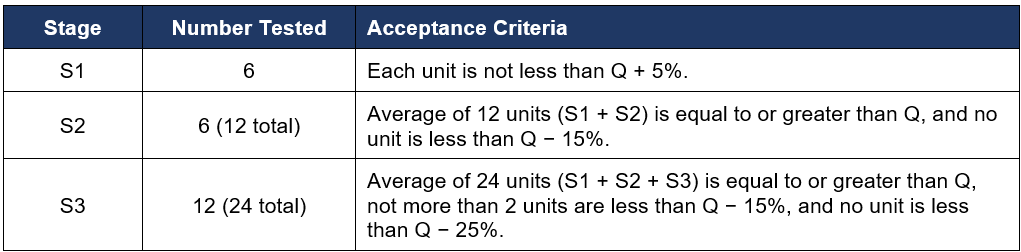
Q is the amount of active ingredient specified to dissolve, expressed as a percentage of label claim. The 5%, 15%, and 25% values are also percentages of label claim, so Q and these tolerances are always in the same units.
Reading the Table Correctly
• S1 is strict but requires the fewest units: every single one of the 6 units must clear Q + 5%.
• S2 relaxes the target to the average of all 12 units, but adds a floor — no individual unit may fall below Q − 15%.
• S3 relaxes further on individual units (up to 2 of 24 may fall between Q − 15% and Q − 25%) but still requires the 24-unit average to meet Q.
• Testing stops the moment a stage's criteria are met — there is no requirement to continue to S2 or S3 if S1 passes.
Worked Example
Consider an immediate-release tablet with Q = 80% at the specified time point. That places the S1 threshold at Q + 5% = 85%, and the S2 individual-unit floor at Q − 15% = 65%.
Stage 1 (S1) — 6 Units

Units 3 (84%) and 5 (79%) fall below the 85% threshold, shown in red. S1 requires every unit to clear that bar, so this batch does not pass at S1 — even though 4 of 6 units look strong — and testing proceeds to S2.
Stage 2 (S2) — 6 Additional Units

Related Article: How to Compare Dissolution Profiles Using f1 and f2: Step-by-Step Example
Do you have any questions or suggestions? Feel free to reach us by clicking here.
Frequently Asked Questions
-
“Q” represents the percentage of the labeled active ingredient that must dissolve within a specified time period according to regulatory specifications.
-
USP <711> dissolution testing generally includes three stages:
Stage 1 (S1)
Stage 2 (S2)
Stage 3 (S3)
Testing may stop early if acceptance criteria are met at S1 or S2.
-
In Stage 1:
Six dosage units are tested.
Each unit must meet the required dissolution criteria, typically Q + 5%.
If all six units pass, testing ends successfully.
-
If Stage 1 fails:
An additional six dosage units are tested in Stage 2.
The combined average and individual results are evaluated against USP <711> acceptance criteria.
-
For Stage 2:
A total of 12 units are evaluated.
The average of all units must be equal to or greater than Q.
No individual unit should fall below Q − 15%.
-
If Stage 2 still fails:
Twelve more units are tested, resulting in 24 total units.
Additional limits such as Q − 25% are evaluated alongside the overall average.
-
Testing may stop:
After Stage 1 if all criteria are met.
After Stage 2 if Stage 2 criteria are satisfied.
Stage 3 is only required if Stage 2 fails.
Get free pharmaceutical analytical calculation examples, Excel tools, and articles delivered to your inbox.