USP <711> Stage Testing for Delayed-Release Tablets: Acid Stage and Buffer Stage Explained (With a Worked Example)
Why Delayed-Release Testing Is Different
Delayed-release (DR) dosage forms — typically enteric-coated tablets or capsules — are designed to survive the acidic environment of the stomach intact and then release their contents once they reach the higher pH of the intestine. USP <711> tests both halves of that promise in sequence: an Acid Stage that confirms the coating holds up, followed by a Buffer Stage that confirms the drug actually comes out once it's supposed to.
This is a meaningful shift from immediate- and extended-release testing. In the Acid Stage, a low dissolution result is the passing result — you want the coating to resist the acid. In the Buffer Stage, the logic flips back to a floor, the same way it works for immediate-release products. Mixing up which direction “pass” runs in is one of the more common review errors with DR data.
Both stages use the same escalating three-level design as IR and ER testing (here labeled A1/A2/A3 for the Acid Stage and B1/B2/B3 for the Buffer Stage), and testing may stop as soon as both stages' criteria are satisfied at the same level.
Acid Stage — Acceptance Table 3
Unless otherwise specified in the individual monograph, the Acid Stage requirements are met if the quantities dissolved conform to:
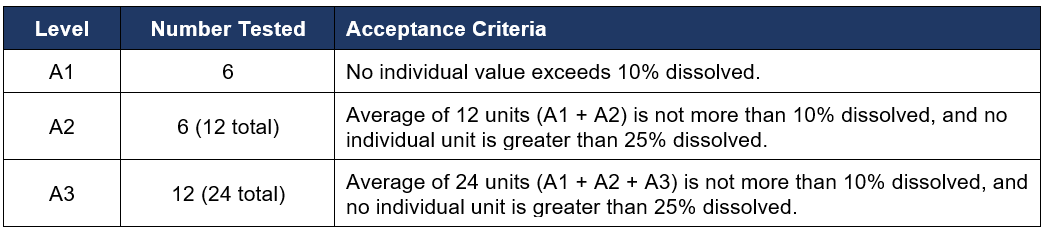
Note the direction of these limits: they are ceilings, not floors. A unit that dissolves more than expected in acid has failed to resist it — this is the opposite pattern from every other release-testing scenario in USP <711>.
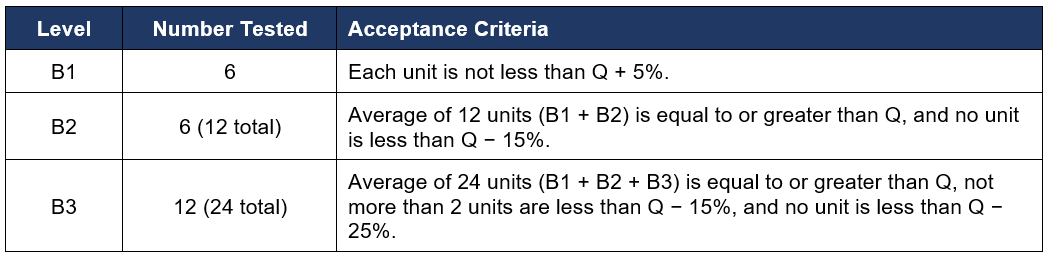
Buffer Stage — Acceptance Table 4
Unless otherwise specified, the requirements are met if the quantities dissolved in the Buffer Stage conform to Acceptance Table 4. Q here is the total amount of active ingredient dissolved across both the Acid and Buffer Stages, expressed as a percentage of labeled content, and defaults to 75% dissolved unless the monograph specifies otherwise:
Worked Example
Consider an enteric-coated tablet with the default Buffer Stage value, Q = 75%. That puts the Buffer Stage B1 threshold at Q + 5% = 80%, and the B2/B3 individual-unit floor at Q − 15% = 60%.
Acid Stage, Level A1 — 6 Units (2 Hours in 0.1N HCl)

Unit 3 dissolves 12% in acid — above the 10% ceiling, shown in red. A1 allows no individual value above 10%, so this batch does not pass at A1 and testing proceeds to A2.
Acid Stage, Level A2 — 6 Additional Units

A2 is evaluated on the combined 12 units. The average across all 12 is 6.9%, comfortably under the 10% ceiling, and the highest individual value (12%, from Unit 3) is well under the 25% cap that A2 allows for individual units. Both A2 conditions are satisfied, so the batch passes the Acid Stage at this level.
Buffer Stage, Level B1 — Same 12 Units (After Transfer to pH 6.8 Buffer)

Unit 3 — the same unit that ran high in acid — comes in at 77% in buffer, below the 80% (Q + 5%) threshold, shown in red. B1 requires every unit to clear that bar, so the Buffer Stage does not pass at B1 and testing proceeds to B2.
Buffer Stage, Level B2 — 6 Additional Units

B2 is evaluated on the combined 12 units. The average of all 12 buffer results is 86.7%, above Q (75%), and the lowest individual value is 77%, above the Q − 15% floor of 60%. Both B2 conditions are satisfied, so the Buffer Stage passes at B2 — and with both the Acid and Buffer Stages now resolved, testing stops with no need for A3 or B3.
Why This Matters for Interpretation
A single high acid result or a single low buffer result at the first level isn't a failed batch — it's a signal to pull the next set of units. What sinks a DR batch is failing to satisfy both stages by A3/B3, or seeing a pattern (several units failing, not just one borderline result) that suggests a genuine coating or formulation issue rather than ordinary unit-to-unit variability.
Practical Tips
• Confirm which Method (A or B) and which apparatus the monograph specifies — delayed-release testing is not accepted by the Japanese Pharmacopoeia, so harmonized monographs may handle this differently.
• Keep Acid Stage and Buffer Stage results tied to the same physical units; the same 6 or 12 units carry through both stages sequentially, they are not independent samples.
• Double-check the direction of each criterion before flagging a result — Acid Stage is a ceiling, Buffer Stage is a floor, and reversing the logic is an easy mistake under time pressure.
Skip the Manual Math: Dissolution Stage Testing Calculator
Enter each unit's percent dissolved for both the Acid and Buffer Stages and our Dissolution Stage Testing calculator automatically applies the correct ceiling or floor criteria, flags failing values, and tells you whether to stop or proceed — all three levels for both stages (A1–A3, B1–B3) in one worksheet.
Reference
United States Pharmacopeial Convention. General Chapter <711> Dissolution. Official December 1, 2011 (Stage 6 Harmonization).
Do you have any questions or suggestions? Feel free to reach us by clicking here.
Frequently Asked Questions
-
“Q” represents the percentage of the labeled active ingredient that must dissolve within a specified time period according to regulatory specifications.
-
USP <711> dissolution testing generally includes three stages:
Stage 1 (S1)
Stage 2 (S2)
Stage 3 (S3)
Testing may stop early if acceptance criteria are met at S1 or S2.
-
In Stage 1:
Six dosage units are tested.
Each unit must meet the required dissolution criteria, typically Q + 5%.
If all six units pass, testing ends successfully.
-
If Stage 1 fails:
An additional six dosage units are tested in Stage 2.
The combined average and individual results are evaluated against USP <711> acceptance criteria.
-
For Stage 2:
A total of 12 units are evaluated.
The average of all units must be equal to or greater than Q.
No individual unit should fall below Q − 15%.
-
If Stage 2 still fails:
Twelve more units are tested, resulting in 24 total units.
Additional limits such as Q − 25% are evaluated alongside the overall average.
-
Testing may stop:
After Stage 1 if all criteria are met.
After Stage 2 if Stage 2 criteria are satisfied.
Stage 3 is only required if Stage 2 fails.
Get free pharmaceutical analytical calculation examples, Excel tools, and articles delivered to your inbox.