USP <711> Stage Testing for Extended-Release Tablets: L1, L2, L3 Explained (With a Worked Example)
How Extended-Release Testing Differs from Immediate-Release
Extended-release (ER) dosage forms are evaluated at multiple time points — typically three — rather than a single time point. Each time point has its own acceptance range (commonly written Q1, Q2, Q3 in the monograph), and the final time point is usually a not-less-than (NLT) minimum rather than a range. A unit has to track the intended release profile the whole way through, not just hit one number at the end.
Because there are more numbers to satisfy per unit, USP <711> uses the same escalating three-level design as immediate-release testing — Levels L1, L2, and L3 — but the criteria are built around ranges instead of a single Q + 5% cutoff, and the tolerance for outliers widens gradually as more units are added.
The Acceptance Criteria (Extended-Release)
Per USP <711>, unless otherwise specified in the individual monograph, the requirements are met if the quantities of active ingredient dissolved conform to Acceptance Table 2:
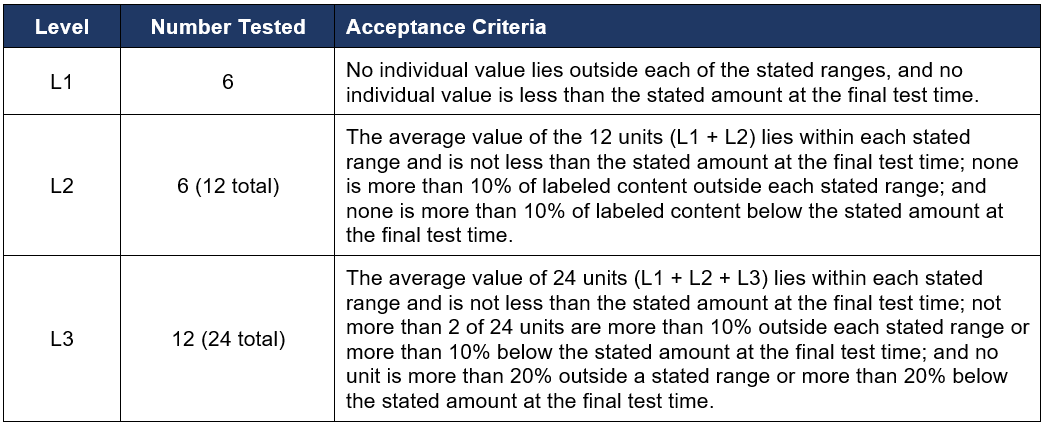
The limits embrace each value of Qi — the amount dissolved at each specified fractional dosing interval. Where more than one range is specified, the acceptance criteria apply individually to each range.
Reading the Table Correctly
• L1 requires every one of the 6 units to fall inside every stated range, and to meet the stated minimum at the final timepoint — with zero tolerance for outliers.
• L2 shifts the target to a 12-unit average per time point, but still enforces an individual-unit tolerance: no more than 10% of labeled content outside a range, or below the final timepoint minimum.
• L3 relaxes the individual-unit tolerance to 20%, but caps how many of the 24 units may deviate (no more than 2 beyond the 10% band).
• As with immediate-release testing, testing stops as soon as a level's criteria are satisfied — there is no obligation to proceed to L2 or L3 once L1 passes.
Worked Example
Consider an extended release tablet with a monograph specifying three time points: 2hr (20–40% dissolved), 6hr (45–65% dissolved), and 12hr as the final time point (not less than 80% dissolved).
Level 1 (L1) — 6 Units

Unit 3 falls below the range for the 2hr timepoint (18% vs. the 20% floor), and Unit 4 falls below the range for the 6hr (42% vs. the 45% floor) and below the 12hr timepoint minimum (79% vs. 80%), all shown in red. L1 allows zero individual values outside a stated range or below the final-time minimum, so this batch does not pass at L1 and testing proceeds to L2.
Level 2 (L2) — 6 Additional Units

L2 is evaluated on the combined 12 units, averaged at each time point:

All three 12-unit averages meet their stated range or minimum. The individual out-of-range values from L1 (Unit 3 at 2hr, Unit 4 at 6hr and 12hr timepoints) each deviate by only 1–3 percentage points — well inside the 10% individual-unit tolerance L2 allows. Both L2 conditions are satisfied, so the batch passes at L2 and testing stops — no L3 units are needed.
Why This Matters for Interpretation
For ER products, a single unit missing a range at one time point does not automatically mean the batch fails — it means L1 wasn't met and L2 data is required. L2's individual-unit tolerance (10% of labeled content) exists precisely to distinguish ordinary unit-to-unit variability from a genuine release-profile problem. Treating an L1 miss as a final result, without evaluating it against the correct level's criteria, is a common source of unwarranted OOS investigations for ER products.
Practical Tips
• Confirm every Qi range and the final time point's minimum directly from the individual monograph — <711> only supplies the pass/fail framework, not the numeric limits.
• Track each time point's acceptance separately per unit; a unit can pass Hour 2 and Hour 6 but fail at the final time point, or vice versa.
• At L2 and L3, distinguish the average-based criterion from the individual-unit tolerance — a batch can satisfy one and not the other.
• Document which level's criteria were used to close out testing, and why — this is standard audit trail expectation for ER dissolution data.
Reference
United States Pharmacopeial Convention. General Chapter <711> Dissolution. Official December 1, 2011 (Stage 6 Harmonization).
Skip the Manual Math: Dissolution Stage Testing Calculator
Enter each unit’s percent dissolved at each time point and our Dissolution Stage Testing calculator automatically applies the correct range or minimum, flags failing values, and tells you whether to stop or proceed — all three levels (L1, L2, L3) in one worksheet.
Do you have any questions or suggestions? Feel free to reach us byclicking here.
Frequently Asked Questions
-
“Q” represents the percentage of the labeled active ingredient that must dissolve within a specified time period according to regulatory specifications.
-
USP <711> dissolution testing generally includes three stages:
Stage 1 (S1)
Stage 2 (S2)
Stage 3 (S3)
Testing may stop early if acceptance criteria are met at S1 or S2.
-
In Stage 1:
Six dosage units are tested.
Each unit must meet the required dissolution criteria, typically Q + 5%.
If all six units pass, testing ends successfully.
-
If Stage 1 fails:
An additional six dosage units are tested in Stage 2.
The combined average and individual results are evaluated against USP <711> acceptance criteria.
-
For Stage 2:
A total of 12 units are evaluated.
The average of all units must be equal to or greater than Q.
No individual unit should fall below Q − 15%.
-
If Stage 2 still fails:
Twelve more units are tested, resulting in 24 total units.
Additional limits such as Q − 25% are evaluated alongside the overall average.
-
Testing may stop:
After Stage 1 if all criteria are met.
After Stage 2 if Stage 2 criteria are satisfied.
Stage 3 is only required if Stage 2 fails.
Get free pharmaceutical analytical calculation examples, Excel tools, and articles delivered to your inbox.