How to Calculate USP <905> Content Uniformity in Excel
What is Content Uniformity in Pharma?
Content uniformity is a standardized test that verifies every tablet, capsule, or unit dose delivers consistent amounts of the active pharmaceutical ingredient (API).
Content uniformity involves assaying each individual unit using an analytical method and comparing the results against established acceptance criteria from the USP.
How the Content Uniformity Test Works
Solid Dosage Forms
Assay 10 units individually using an appropriate analytical method
Calculate the acceptance value
Liquid Dosage Forms
Assay 10 units individually using an appropriate analytical method
Perform assay on the amount of well - mixed material that is removed from an individual container in conditions of normal use
Express results as delivered dose
Calculate the acceptance value
Requirement to pass content uniformity
Acceptance value must be less than or equal to L1%
If acceptance value > L1%, test additonal 20 units and calculate acceptance value. The requirements are met if the final acceptance value of the 30 dosage units is ≤ L1%, and no individual content of any dosage unit is less than [1 − (0.01)(L2)]M nor more than [1 + (0.01)(L2)]M
Where:
L1 = 15.0, unless otherwise specified
L2 = 25.0, unless otherwise specified
The acceptance value is |M-X̄| + ks
Where:
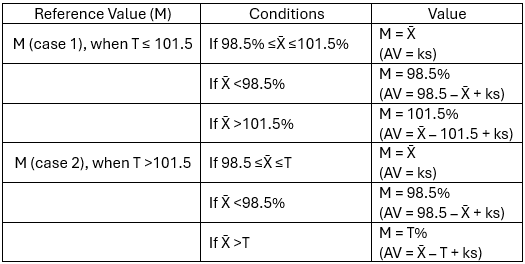
T = target content per dosage unit at the time of manufacture, expressed as a percentage of the label claim. Unless otherwise stated, T is 100.0% or T is the manufacturer’s approved target content per dosage unit.
X̄ is the mean of individual assay values, expressed % label claim
k = 2.4, if n=10 or k = 2.0, if n=20
s is the sample standard deviation
Reference: USP <905) Uniformity of Dosage Units
Read related article on Weight Variation in Pharmaceutical Analysis.
Feeling overwhelmed? Simplify the process with our content uniformity calculator. Quickly perform these calculations and make your life easier!
Content Uniformity Calculator Preview
Enter the % Label Claims for 10 dosage units, and the template will automatically calculate the acceptance value. It will also indicate whether the data passes or fails the test based on USP <905>.
Frequently Asked Questions
-
Content uniformity is a test described in USP <905> that evaluates whether individual dosage units contain the intended amount of API. The test ensures that each unit in a batch delivers a consistent dose to the patient.
-
10 dosage units are tested first. If the batch fails, 20 additional units are tested (total of 30).
-
The value of k depends on the number of dosage units tested. For a sample size of 10, k = 2.4, while for a sample of 30, k = 2.0
Get free pharmaceutical analytical calculation examples, Excel tools, and articles delivered to your inbox.